Brace Expansion Is Hard
tl;dr: If you depend on the bracex Python library, and there’s a good chance you do but haven’t noticed yet, upgrade to version 3.0.
A few weeks ago, I had a shower thought about supply chain security. More precisely, I wondered which packages in the PyPI ecosystem were common transitive dependencies but often overlooked by security researchers.
Digging around, I stumbled across bracex, a Python library for Bash-style brace expansion. You know, the feature that converts foo{bar,baz} into foobar foobaz. Since that’s a fundamental functionality, it’s no surprise the package is downloaded a lot.
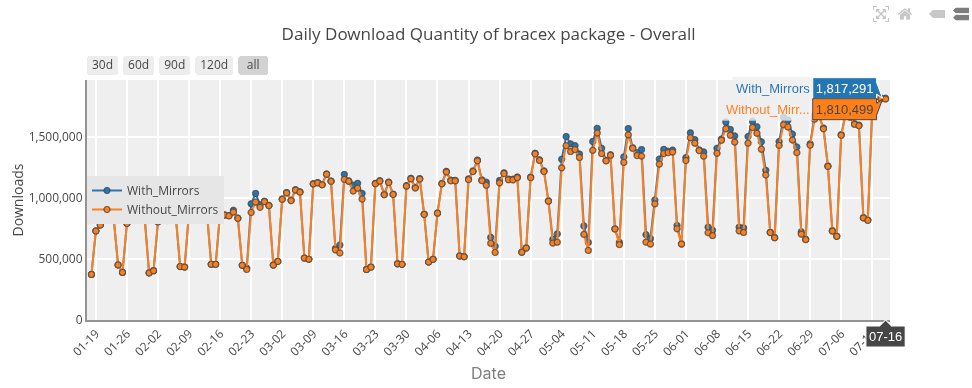
bracex download statisticsBrace expansion can easily lead to a combinatoric explosion if you’re not careful. bracex==2.6 ships a limit parameter, which is supposed to stop a pattern from expanding into an unreasonable number of results. All three bugs below are, in one way or another, a story about it counting the wrong thing.
CVE-2026-62980
Also GHSA-88pj-cgpg-492r. get_literals walks the input character by character and folds each one into the result with squash:
result = iter([''])
...
while c:
 value = [c]
 ...
    # Squash the current set of literals.
 result = self.squash(result, value)
 c = next(i)
And squash is a generator:
def squash(self, a, b):
    for x in itertools.product(a, b):
        yield ''.join(x) if isinstance(x, tuple) else x
Notice that it never consumes a. It wraps it. So parsing "abc" doesn’t build the string "abc". It builds a generator, over a generator, over a generator. Thus, N characters produce N nested generators, which only get unrolled when something finally iterates the outermost one. Every next() has to descend through all N stack frames. Stack depth ends up proportional to input length.
Which means this is enough:
bracex.expand("a" * 4000)
A string with no braces in it at all, whose only correct output is itself, raises RecursionError once its length approaches the recursion limit. The limit protection never gets consulted here. For brace-free input, the parser calls update_count(1) exactly once at the end, because there is exactly one result. With recursion errors like this, if the application has raised its recursion limit, we can even use this to trigger a segfault and crash the interpreter.
Disclosed on June 27, 2026, and fixed on June 28, 2026, in bracex==2.7.
CVE-2026-62981
Also GHSA-q3p5-v4g2-85hm. Normal slots in {a,b} are parsed by get_literals, which calls update_count(1) for each. However, an empty slot, e.g., from ,,, a leading ,, or a trailing ,, takes a shortcut:
elif c == ',':
    # Must be the first element in the list.
 has_comma = True
    if is_empty:
 result = itertools.chain(result, [''])
    else:
 is_empty = True
The empty string gets chained onto the result, and the counter is never touched. The slot exists in the output but not in the accounting. So the limit does not really apply here:
>>> len(bracex.expand("-v{" + ","*5000 + "}", limit=1000))
5001
It also compounds, because group sizes are multiplied together:
def update_count_seq(self, count: list[int]) -> None:
    self.count -= sum(count)
 prod = 1
    for c in count:
 prod *= c
    self.update_count(prod)
A group consisting only of empty slots reports a size of 0, which zeroes out the product for every group around it. "x{,,}"*16 is roughly 43 million results, none of which get counted.
Even cooler, every empty slot wraps the result in another itertools.chain, so draining it recurses through the C stack, past the point where Python can still raise a RecursionError. On my standard testing machine, "{" + ","*500000 + "}" segfaulted instantly.
Disclosed on June 27, 2026, and fixed on June 28, 2026, in bracex==2.7.
CVE-2026-63185
Also GHSA-f5rx-pv38-28f9. This is my favorite of the three. When get_literals meets a {, it optimistically asks get_sequence for a group. If the string runs out before a matching } is observed, get_sequence raises StopIteration and the parser rewinds:
elif not ignore_brace and c == '{':
    # Try and get the group
 index = i.index
    try:
 current_count = self.count
 seq = self.get_sequence(next(i), i, depth + 1)
 ...
    except StopIteration:
        # Searched to end of string
        # and still didn't find it.
 i.rewind(i.index - index)
The rewind puts the cursor back to just after the {, and the loop carries on treating it as an ordinary literal. Everything get_sequence just scanned gets scanned a second time. And if that remainder contains another {, it plays the same trick again.
Each unmatched brace therefore doubles the parse: N braces cost 2^(N-1) calls into get_sequence. On 2.6, "{" * 16 invokes it 32,767 times. About 30 bytes of { were enough to effectively halt execution. limit does not really help here, because it counts results, and a failed parse does not produce any. The work never gets accounted for.
Disclosed on June 27, 2026, and fixed on June 30, 2026, in bracex==3.0.
Lessons Learned
First and foremost, a big shoutout and thanks to @facelessuser, the maintainer behind bracex. All findings were fixed within three days after disclosure. That deserves a lot of respect.
On a technical level, all three vulnerabilities share a theme. Resource limits were enforced by counting results. So each exploit found a way to burn resources without producing any. A long literal is one result, an empty slot is a result nobody counted, a failed parse is no result at all. The guard rail measured outputs when it should have measured work.
The other half of the theme is generators. squash and itertools.chain are cheap to stack up and expensive to drain. Code that looks like it’s just assembling strings ends up accumulating stack frames. Making code lazy is great, but it comes at a cost.
If you depend on bracex, and there’s a good chance you do but haven’t noticed yet, upgrade to version 3.0.